
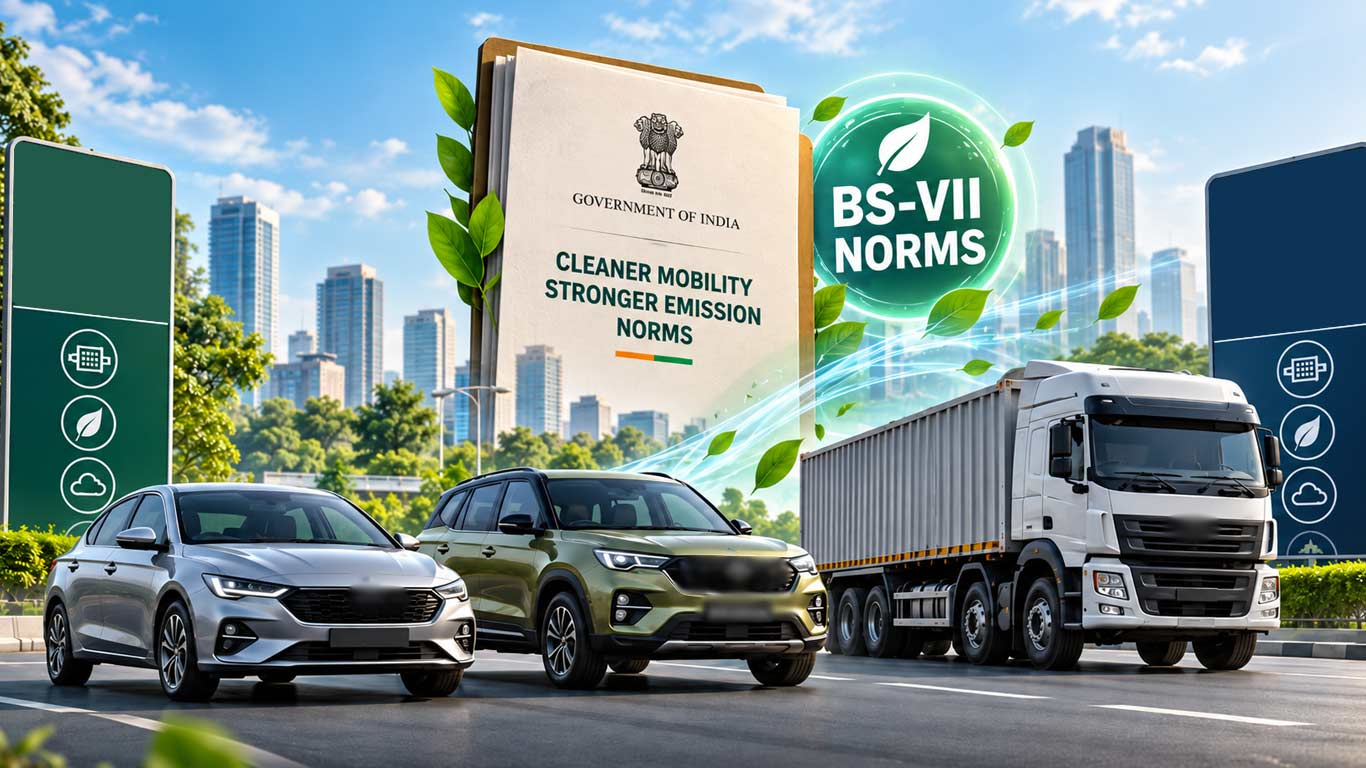
India is planning to strengthen its environmental regulations through the introduction of Bharat Stage VII (BS-VII) emission standards, aligned with the European Euro 7 requirements. The new framework will be implemented in three phases and aims to reduce vehicle emissions while improving the monitoring of environmental performance. For commercial vehicles, implementation is scheduled to begin in 2030.
The proposed timeline varies according to vehicle category. Light commercial vehicles in category N1 will be subject to the new standards from 1 April 2030, with subsequent phases scheduled for April 2032 and April 2035. For trucks and buses in categories N2, N3, M2 and M3, the first phase will take effect on 1 April 2031, followed by further stages in April 2033 and April 2035. Passenger cars and SUVs are expected to be covered earlier, from April 2029.
Technically, the BS-VII standards will incorporate key elements of the European Euro 7 framework, including stricter emission requirements and particle number measurements covering PN10 particles, which are larger than 10 nanometres. The proposed regulations will also address non-exhaust emissions, extending pollution controls to particles generated by brake wear and tyre abrasion.
The framework will further strengthen onboard monitoring and diagnostic systems. On-board diagnostics (OBD), on-board monitoring (OBM) and on-board fuel and energy consumption monitoring (OBFCM) systems will help improve the tracking of vehicle emissions and energy performance under real-world operating conditions.
Another significant measure is the introduction of an Environmental Vehicle Passport (EVP) for each vehicle. This passport will provide information on fuel or energy consumption, emissions and battery health. Specific requirements will also apply to battery electric vehicles (BEVs) and hybrid vehicles, establishing minimum performance and battery capacity retention thresholds over defined periods or mileage limits.
Through this reform, India aims to bring its vehicle emission regulations closer to European standards while tightening environmental requirements across the automotive sector. The phased introduction of BS-VII is expected to represent a major step towards reducing transport-related pollution, while requiring manufacturers to adapt their technologies to meet increasingly demanding standards for emissions control, onboard monitoring and vehicle durability.
En savoir plus sur Fluides et Lubrifiants
Abonnez-vous pour recevoir les derniers articles par e-mail.


